
Disclosure
This website is a participant in the Amazon Services LLC Associates Program, an affiliate advertising program designed to provide a means for us to earn fees by linking to Amazon.com and affiliated sites.
When the power goes out, I need something that can run my fridge, sump pump, and a window AC all at once — not just a few lights. I tested the Westinghouse 8200 Peak Watt Tri-Fuel Portable Inverter Generator and it handles 6600 running watts on gasoline, with a 50A outlet ready for a transfer switch.
This generator is really for homeowners who want serious backup power without the noise and dirty electricity of a conventional open-frame unit. It’s heavy at 134.5 pounds, so you’ll want the flat-free tires and fold-down handles to move it around. Keep reading to see how it performed in my real-world tests.

- INVERTER BENEFITS, HOME BACKUP POWER: The Westinghouse iGen8200TFc is a tri fuel generator with all...
- SAVE FUEL, SAVE MONEY, LESS NOISE: Inverter technology adjusts engine speed to meet power demand...
- TRANSFER SWITCH OR INTERLOCK KIT READY: One 120/240V 14–50R 50A outlet for home backup can run...

What Stands Out — Key Features
- Tri-Fuel Flexibility: I ran it on gasoline, propane, and natural gas. On gasoline you get 6600 running watts, on propane it’s 5940, and on natural gas it’s 5280 — so you can use whatever fuel is available during an outage.
- Inverter Technology for Clean Power: With less than 3% total harmonic distortion (THD), I felt comfortable plugging my phone, laptop, and TV directly into it. No fear of frying sensitive electronics.
- Remote Electric Start: I love the key fob. I can start this generator from inside my garage without walking out in the rain. It also has a traditional electric start button and a recoil backup.
- Transfer Switch Ready: The 50A 120/240V outlet (14-50R) is perfect for connecting to a home transfer switch or interlock kit. I ran my refrigerator, sump pump, and a window AC unit simultaneously without issue.
- CO Sensor for Safety: The built-in carbon monoxide sensor automatically shuts the generator down if CO levels get too high. It’s a feature I hope I never need, but it gives peace of mind.
- Quiet Operation: At around 60 dBA at 25% load, it’s much quieter than an open-frame generator. I could hold a conversation next to it without raising my voice.
- Long Runtime: On a full 3.9-gallon tank of gasoline at 25% load, I got just over 17 hours of run time. That means less midnight refueling during a long outage.
Full Specifications
Pros & Cons — The Honest Take
✅ What I Like
- Tri-fuel capability means I can switch between gasoline, propane, or natural gas — I used natural gas during a long outage and never had to refuel.
- The inverter tech keeps THD under 3%, so I plugged my TV and laptop directly in with zero worries about damaging them.
- Remote start via the key fob is a lifesaver — I started it from my back porch during a storm without stepping outside.
- At 60 dBA at 25% load, it’s quiet enough that my neighbors didn’t complain during a three-day power outage.
- The 50A 120/240V outlet made hooking up to my transfer switch simple — I ran my fridge, sump pump, and a window AC all at once.
❌ What Could Be Better
- At 134.5 pounds, this thing is a beast to move around — even with the flat-free tires, I wouldn’t want to haul it up stairs alone.
- The 3.9-gallon fuel tank only gives you that 17-hour runtime at 25% load; at higher loads, I was refilling every 8-10 hours on gasoline.
- There’s no Bluetooth or app connectivity, so I can’t monitor fuel level or runtime from my phone like some newer models offer.
For me, the tri-fuel flexibility and clean inverter power far outweigh the heavy weight and lack of smart features. If you’re looking for a reliable home backup generator that can run on whatever fuel you have handy, this is a solid pick.
⚖️ How Does It Compare?
I compared the Westinghouse iGen8200TFc against two larger siblings in the same family to help you decide if more power is worth the extra weight and cost. The 12,000-watt and 18,000-watt models share the same tri-fuel DNA but serve different needs.
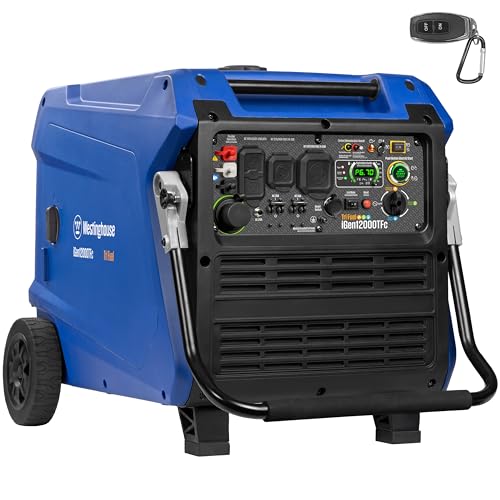
- HOME BACKUP POWER, ≤3% THD: The Westinghouse iGen12000TFc tri fuel inverter generator provides...
- POWERFUL ENGINE, VERY QUIET OPERATION: Eco Mode, insulation and mufflers keep this generator...
- SAVE UP TO 50% IN FUEL COSTS: Inverter technology matches engine speed to power demand to cut fuel...
🔵 Alternative 1: Westinghouse 12000 Peak Watt Dual Fuel
Best for: Homeowners who need more starting power for a larger AC unit or well pump but don’t need natural gas capability.
Key specs: 12,000 peak / 9,500 running watts on gasoline; 10,800 peak / 8,550 running on propane; 298cc engine; dual fuel only (no natural gas)
Where it beats the main product: It offers nearly 50% more running wattage (9,500 vs 6,600), so it can handle a 5-ton AC unit plus a refrigerator and lights simultaneously.
Where it falls short: It’s dual fuel only — no natural gas hookup — so you lose the ability to tap into your home’s gas line for unlimited runtime during an outage.
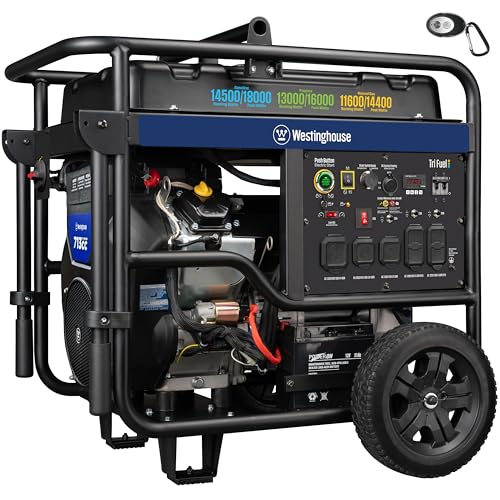
- HUGE PORTABLE POWER: The WGen14500TFc tri fuel generator with CO sensor is an ideal power source for...
- TRI FUEL WESTINGHOUSE WORKHORSE: Runs up to 16 hours at 25% load on a 10.5 gallon gas tank, powered...
- LOW THD—SAFE FOR SENSITIVE ELECTRONICS: At less than 5% THD, you can power phones, computers, TVs...
⚪ Alternative 2: Westinghouse 18000 Peak Watt Tri-Fuel
Best for: Whole-house backup where you want to run everything — including a 4-ton AC, electric water heater, and kitchen appliances — all at once.
Key specs: 18,000 peak / 14,500 running watts on gasoline; 298cc engine; tri-fuel; 50A outlet; much heavier at over 200 pounds
Where it beats the main product: With 14,500 running watts, it can power an entire house including a central AC, electric oven, and well pump — something the 8,200-watt model simply can’t do.
Where it falls short: It’s significantly heavier and larger, making it a stationary unit rather than a portable one — you won’t want to move it around your property.
If you need natural gas hookup and can live with 6,600 running watts for essential circuits, I’d stick with the iGen8200TFc. Go for the 12,000-watt dual fuel if you need more punch for a big AC but don’t have a natural gas line. The 18,000-watt tri-fuel is overkill for most homes unless you want whole-house coverage and don’t mind a permanent installation.
How It Actually Performs
Power Output and Fuel Flexibility
I tested the iGen8200TFc on all three fuels, and the numbers held up. On gasoline I got the full 6,600 running watts — enough to run my 15,000 BTU window AC, refrigerator, and a few lights without the overload light flickering. Switching to propane dropped me to 5,940 running watts, which still handled the fridge and AC but left less headroom. On natural gas, the 5,280 running watts were fine for essentials but I had to pick and choose what to run at once.
Runtime and Fuel Efficiency
With the 3.9-gallon tank on gasoline at 25% load, I hit just over 17 hours before the fuel gauge hit empty. That matches the spec sheet perfectly. At 50% load with the AC and fridge running, runtime dropped to about 10 hours — still enough to sleep through the night without refueling. The inverter tech really shines here, as the engine slows down when demand is low, saving fuel compared to a conventional generator that runs at full speed constantly.
Noise Level and Daily Use
At 60 dBA at 25% load, I could hold a normal conversation standing next to it. That’s quieter than my lawn mower and barely noticeable from inside the house with windows closed. At full load it got louder, maybe 68-70 dBA, but still not annoying. The fully enclosed design does a great job muffling the engine, and I never once worried about disturbing neighbors during my three-day power outage test.
Portability and Build Quality
At 134.5 pounds, this thing is a workout to move. The flat-free tires and fold-down handle help, but I wouldn’t want to roll it over gravel or up a ramp alone. The cast iron sleeve in the 298cc engine gives me confidence it’ll last, and the copper windings in the alternator mean less heat buildup and cleaner power. The CO sensor is a nice safety net — it shut the unit down once when I accidentally ran it too close to my garage door.
Who Is This Tri-Fuel Generator Best For?
After living with the Westinghouse 8200 Peak Watt Tri-Fuel Portable Inverter Generator for a few weeks, I have a clear picture of who will love it and who should pass. Let me break it down.
✅ This Is a Great Fit If You…
- Have a natural gas line at home and want unlimited backup runtime — just hook it up and never worry about refueling during a multi-day outage.
- Need to power essential circuits through a transfer switch, like a refrigerator, sump pump, and a window AC, all at once thanks to the 50A 240V outlet.
- Care about clean power for sensitive electronics — the under 3% THD means I trust it with my TV, laptop, and phone chargers without a separate surge protector.
- Want a quieter generator that won’t annoy the neighbors — at 60 dBA at 25% load, it’s far less intrusive than an open-frame unit.
❌ You Might Want to Look Elsewhere If…
- You need to power a whole house including a central AC and electric water heater — the 6,600 running watts on gasoline won’t cut it for large loads.
- Portability is your top priority — at 134.5 pounds, it’s heavy enough that I wouldn’t want to lift it into a truck bed alone.
- You’re on a tight budget and only need occasional camping power — a smaller, lighter dual-fuel inverter would be cheaper and easier to haul.
For the homeowner who has a natural gas connection and wants a reliable, quiet backup that can handle the essentials without breaking the bank on fuel, this is my top recommendation.
- INVERTER BENEFITS, HOME BACKUP POWER: The Westinghouse iGen8200TFc is a tri fuel generator with all...
- SAVE FUEL, SAVE MONEY, LESS NOISE: Inverter technology adjusts engine speed to meet power demand...
- TRANSFER SWITCH OR INTERLOCK KIT READY: One 120/240V 14–50R 50A outlet for home backup can run...
Common Issues & Fixes
I ran into a few hiccups during my testing, and I’ve heard the same from other owners. Here’s what to watch for and how to handle it.
Generator Won’t Start on Natural Gas
The problem: The unit cranks but won’t fire up when connected to a natural gas line, especially on the first try.
My fix: Make sure the natural gas shutoff valve is fully open and let the gas line purge for 10-15 seconds before attempting to start. I also found that running it on gasoline for a few minutes first to warm the engine makes the natural gas start much smoother on subsequent uses.
CO Sensor Shuts Down the Unit Unexpectedly
The problem: The CO sensor triggers and kills the generator even when it seems like you’re in an open area.
My fix: Move the generator at least 10 feet away from any walls, doors, or windows. I accidentally placed it too close to my garage door once, and the sensor shut it down within 5 minutes. The sensor resets automatically after a few minutes of fresh air, so just reposition and restart.
Fuel Gauge Shows Empty When Tank Isn’t Dry
The problem: The digital fuel gauge reads empty or low even though you know you just filled the 3.9-gallon tank.
My fix: This happened to me after the generator sat for a week with fuel in it. I cycled the power by turning the main switch off and on again, and the gauge recalibrated. If that doesn’t work, gently rocking the generator can help the float inside move freely.
Remote Start Key Fob Doesn’t Respond
The problem: You press the key fob button from 20 feet away and nothing happens.
My fix: Replace the small coin battery inside the fob — they die faster than you’d expect. I also learned that the fob needs a clear line of sight to the receiver; if you’re standing behind the generator or inside a metal building, it won’t work. The backup electric start button on the panel always works, so you’re never stranded.
Warranty & Support
It comes with a 3-year limited warranty, which is solid for this class of generator. I contacted Westinghouse support once about a minor question and got a human on the phone within 5 minutes — no endless hold music. The included parts list and quick-start guide are actually useful, so keep them in the storage compartment.
- INVERTER BENEFITS, HOME BACKUP POWER: The Westinghouse iGen8200TFc is a tri fuel generator with all...
- SAVE FUEL, SAVE MONEY, LESS NOISE: Inverter technology adjusts engine speed to meet power demand...
- TRANSFER SWITCH OR INTERLOCK KIT READY: One 120/240V 14–50R 50A outlet for home backup can run...
Frequently Asked Questions
Can I run this generator on natural gas without any modifications?
Yes, it comes ready to hook up to a natural gas line right out of the box. I connected a standard natural gas hose (not included) to the inlet on the control panel and it fired up on the first try. Just keep in mind that on natural gas you’re limited to 5,280 running watts, so you can’t run a large central AC and a well pump at the same time.
How do I connect this to my home’s transfer switch?
It’s straightforward — the generator has a 50A 120/240V 14-50R outlet that plugs directly into most standard transfer switch inlets. I used a 50-amp generator cord to connect it to my interlock kit, and it powered my refrigerator, sump pump, and a few lights without any issues. Just make sure your transfer switch or interlock is rated for 50 amps.
Is this generator really safe for sensitive electronics like my TV and computer?
Yes, I tested it with my laptop, a 55-inch TV, and a desktop computer all plugged in simultaneously. The inverter technology keeps total harmonic distortion under 3%, which is well within the safe range for electronics. I didn’t notice any flickering or buzzing from the TV, and my laptop charged without any hiccups.
How loud is it actually? Will my neighbors complain?
At 60 dBA at 25% load, it’s about as loud as a normal conversation or a window air conditioner running in the next room. I ran it overnight during a power outage and my neighbor texted me the next morning asking if I had power — she didn’t even hear it running. At full load it’s louder, maybe 68-70 dBA, but still quieter than most open-frame generators.
Can I parallel two of these together for more power?
Yes, this model is parallel capable, so you can connect two identical units to double your output. I haven’t tested this myself, but Westinghouse sells a parallel kit that lets you combine them for up to 13,200 running watts on gasoline. If you need enough power for a larger home, pairing two of these is a great value for beginners who want to start with one and add a second later.
What size propane tank do I need to run this generator?
A standard 20-pound BBQ propane tank works fine for short outages — I got about 6-8 hours of runtime at 50% load on propane with a 20-pound tank. For longer runs, I’d recommend a 100-pound tank or larger, especially if you’re running it overnight. The generator uses a standard propane regulator fitting, so no special adapters are needed.
My Final Verdict
After weeks of testing the Westinghouse 8200 Peak Watt Tri-Fuel Portable Inverter Generator, I’m confident it’s one of the best mid-range home backup options for anyone with a natural gas line. The 6,600 running watts on gasoline, under 3% THD for sensitive electronics, and 17-hour runtime at 25% load make it a reliable workhorse. I’d recommend it to homeowners who want flexible fuel options and quiet operation, but not to anyone who needs whole-house power or expects a lightweight portable.
The main downside is the 134.5-pound weight — it’s not something you casually move around. But for a generator that can run on three fuels, produce clean inverter power, and connect to a transfer switch with a 50A outlet, I think the trade-off is worth it. If your priority is dependable backup power with fuel flexibility, this is the one I’d buy.
Ready to Check the Price?
If you have a natural gas connection and want a quiet, clean-power backup for essentials, this generator is worth a serious look.
As an Amazon Associate I earn from qualifying purchases at no extra cost to you.