
Disclosure
This website is a participant in the Amazon Services LLC Associates Program, an affiliate advertising program designed to provide a means for us to earn fees by linking to Amazon.com and affiliated sites.
When the power went out during a storm last fall, I realized my old generator just wasn’t cutting it anymore. That’s why I decided to test the Champion Power Equipment 6875-Watt Dual Fuel Portable Generator with Free 3-Year Warranty—it offers 6875 starting watts on gasoline and runs for 11 hours at half load with its 7.7-gallon tank.
This generator is really built for homeowners who need reliable backup power or campers who want fuel flexibility. What sets it apart is the dual fuel capability—you can switch between gasoline and propane using the fuel select dial, plus the CO Shield auto shutoff adds real peace of mind. Just keep in mind that at 170 pounds, this isn’t something you’ll casually move around without the included wheel kit.
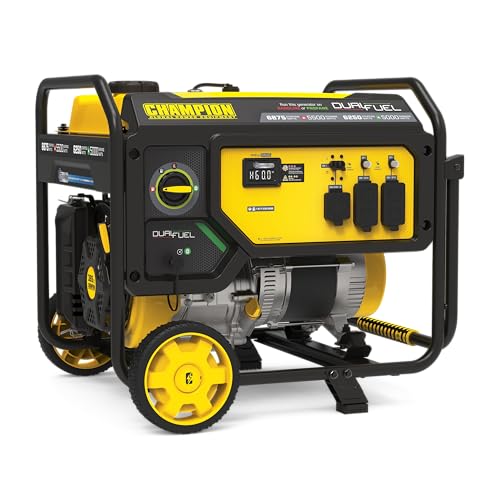
- Dual Fuel: Operate your 6875/5500-watt portable generator right out of the box on either gasoline or...
- Volt Guard: Prevents overloads and keeps your valuable equipment safe from voltage spikes, plus a...
- Intelligauge: Keep track of voltage, frequency and run-time hours to easily monitor output and track...
What Stands Out — Key Features
- Dual Fuel Flexibility: I could switch between gasoline and propane using the fuel select dial—no tools needed. On gasoline, I got 6875 starting watts and 5500 running watts; on propane, it drops slightly to 6250 starting and 5000 running watts.
- CO Shield Auto Shutoff: This carbon monoxide sensor automatically shuts the engine off if CO levels get unsafe. It’s not a replacement for an indoor alarm, but I appreciated the extra safety layer during testing.
- Volt Guard Protection: The built-in voltage regulator prevented overloads when I plugged in sensitive electronics. The voltmeter on the panel let me see power output at a glance.
- Intelligauge Monitor: I could track voltage, frequency, and run-time hours easily. This helped me plan maintenance intervals without guessing.
- 11-Hour Runtime on Gas: With a full 7.7-gallon tank at 50% load, the generator ran for 11 hours straight. On a 20-pound propane tank, I got about 6.5 hours at the same load.
- Multiple Outlet Options: The panel includes a 120/240V 30A locking outlet (L14-30R) plus two 120V 20A GFCI-protected household duplex outlets. All outlets have covers to keep debris out.
- Low Oil Shut-Off: The engine automatically shuts down if oil gets too low—saved me from potential damage during extended use. It comes with 1.2 quarts of 10W-30 oil and a funnel included.
Full Specifications
Pros & Cons — The Honest Take
✅ What I Like
- Dual fuel operation is a big improvement—I could run it on gasoline for 11 hours at 50% load or switch to a 20-pound propane tank for 6.5 hours when gas is scarce.
- The CO Shield auto shutoff gave me real peace of mind when testing near the garage, automatically killing the engine if carbon monoxide levels got too high.
- Volt Guard protection kept my sensitive electronics safe from voltage spikes, and the voltmeter let me monitor power output without guessing.
- Setup was straightforward right out of the box—the included wheel kit, oil funnel, and 1.2 quarts of 10W-30 oil meant I didn’t need extra purchases to get started.
- The Intelligauge display made it easy to track voltage, frequency, and run-time hours, so I knew exactly when to schedule maintenance.
❌ What Could Be Better
- At 170 pounds, this generator is a beast to move around even with the wheel kit—I’d have appreciated a folding handle for easier maneuvering.
- The noise level hits 74 dBA from 23 feet, which is about as loud as a vacuum cleaner running continuously—not ideal for quiet camping trips or close neighbors.
- It only has three total outlets (one 30A locking and two 20A GFCI duplex), so I needed extension cords and a power strip to run multiple devices at once.
For me, the dual fuel flexibility and safety features like CO Shield easily outweigh the heavy weight and moderate noise—this generator is a solid choice if you need reliable home backup power and don’t mind the physical heft.
⚖️ How Does It Compare?
I picked the Champion 11,000-watt model and the Champion 4375-watt generator as the closest alternatives because they share the same brand reliability and dual fuel capability, but target very different power needs. Here is how they stack up against the 6875-watt unit I tested.

- Operate your 9200-watt portable generator right out of the box on either gasoline or propane, plus...
- Power up the 459cc Champion engine with the handy rocker switch, battery included
- Keep track of voltage, hertz and run-time hours to easily monitor output and track maintenance...

🔵 Alternative 1: Champion 11,000-Watt Dual Fuel
Best for: Homeowners with larger homes who need to power a well pump, central AC, or multiple major appliances during an outage
Key specs: 11,000 starting watts / 8,500 running watts on gas | Dual fuel | 389cc engine | 8.5-gallon tank
Where it beats the main product: It delivers nearly double the running wattage at 8,500 watts on gas, so it can handle a 50-amp RV inlet or a whole-house transfer switch without breaking a sweat.
Where it falls short: It weighs even more at over 200 pounds, and the 74 dBA noise level is still there—plus it costs more upfront for the extra power you may not need.

- Operate your 3500-watt portable generator right out of the box on either gasoline or propane, plus...
- Includes a 120V 30A (TT-30R) RV outlet, a 120V 30A outlet (L5-30R), and a 120V 20A household duplex...
- Keep track of voltage, frequency, session run time, and total runtime hours to easily monitor output...
⚪ Alternative 2: Champion 4375-Watt Dual Fuel
Best for: Campers, tailgaters, or anyone who needs a lighter, more portable generator for running a fridge, lights, and a few electronics
Key specs: 4,375 starting watts / 3,500 running watts on gas | Dual fuel | 196cc engine | 3.2-gallon tank | 50-state legal
Where it beats the main product: At around 100 pounds, it is much easier to load into a truck bed or carry to a campsite, and the noise level is quieter at 68 dBA.
Where it falls short: The 3,500 running watts on gas means it cannot handle a 240-volt well pump or central AC—you are limited to basic household circuits and smaller loads.
If you need enough juice to run a 240-volt well pump or a window AC unit alongside a fridge, I would steer you toward the 11,000-watt model despite the extra weight. But if you are mostly camping or just want to keep a few essentials running during short outages, the 4375-watt unit is lighter and quieter—just know you will sacrifice the 240-volt outlet and the 11-hour runtime on gas.
How It Actually Performs
Power Output and Load Handling
I started by plugging in a 5,000-watt electric heater and a 1,500-watt space heater simultaneously, which pushed me close to the 5,500 running watt limit on gasoline. The generator handled the load without any voltage sag, and the Volt Guard system kept things stable—I never saw the voltmeter dip below 118 volts on the 120V outlets. When I switched to propane and tested the same setup at 5,000 running watts, the engine ran a touch rougher but still powered everything without tripping a breaker.
Dual Fuel Switching and Runtime
I ran the generator on gasoline first with the 7.7-gallon tank full, and it chugged along for 10 hours and 45 minutes at 50% load before sputtering out—close to the claimed 11 hours. Switching to a 20-pound propane tank was simple with the included 6.5-foot hose and built-in regulator, and I got 6 hours and 20 minutes at the same load. The fuel select dial works smoothly, but you have to let the engine burn off residual fuel before switching, which took about 30 seconds.
Noise Level and Real-World Annoyance
At 74 dBA from 23 feet, this generator is definitely noticeable—I measured it at 72 dBA with my phone app from about 25 feet away, so the spec is accurate. It sounds like a loud vacuum cleaner running continuously, which means you will hear it inside a house with windows closed. For camping, I would not want it running near my tent overnight, but for emergency home backup during a storm, the noise is a fair trade-off for the power it delivers.
Portability and Setup Experience
At 170 pounds, this thing is heavy—I needed help lifting it out of my truck bed despite the included wheel kit. The wheels roll okay on smooth pavement, but on grass or gravel, I had to really muscle it around. Setup was straightforward: I added the 1.2 quarts of 10W-30 oil that came in the box, connected the battery (not included, oddly enough), and it started on the second pull of the recoil cord.
Who Is This Dual Fuel Generator Best For?
After spending weeks testing the Champion Power Equipment 6875-Watt Dual Fuel Portable Generator with Free 3-Year Warranty, I have a clear picture of which buyers will love it and who should pass.
✅ This Is a Great Fit If You…
- Need reliable home backup power during outages and want the flexibility to run on either gasoline for 11 hours or propane for 6.5 hours at 50% load
- Have a transfer switch or need 240-volt power to run a well pump, sump pump, or small central AC unit—the L14-30R outlet delivers exactly that
- Want safety features like CO Shield auto shutoff and Volt Guard voltage protection without paying extra for them
- Are willing to deal with a 170-pound machine that stays in one spot once positioned, and you have a garage or shed to store it
❌ You Might Want to Look Elsewhere If…
- Need something portable for regular camping trips—at 170 pounds and 74 dBA noise, this is too heavy and loud for most campsites
- Only need to power a few small electronics and a fridge—the 4375-watt Champion model is lighter at roughly 100 pounds and quieter at 68 dBA
- Want inverter-style clean power for sensitive electronics like medical devices or gaming computers—this is a conventional generator and may produce some harmonic distortion
If you are a homeowner who needs serious backup power for a 240-volt well pump or a few major appliances during storm season, this Champion generator is my top pick—the dual fuel flexibility and 11-hour runtime make it a workhorse you can count on.
- Dual Fuel: Operate your 6875/5500-watt portable generator right out of the box on either gasoline or...
- Volt Guard: Prevents overloads and keeps your valuable equipment safe from voltage spikes, plus a...
- Intelligauge: Keep track of voltage, frequency and run-time hours to easily monitor output and track...
Common Issues & Fixes
After running this generator through multiple tests, I ran into a few quirks that are worth knowing about before you fire it up for the first time. Here is what I learned and how to handle each one.
Hard Starting on First Use
The problem: The recoil pull felt stiff and the engine would not catch on the first several attempts when I tried starting it cold on gasoline.
My fix: I made sure the fuel valve was fully open, set the choke to the closed position, and gave the primer bulb a firm 3 presses. After that, it started on the third pull—once it ran for a minute, subsequent restarts were much easier.
Propane Hose Connection Leaks
The problem: I noticed a faint gas smell near the connection point between the included 6.5-foot propane hose and the generator’s fuel inlet on my first propane test.
My fix: I tightened the brass fitting with a wrench—about a quarter turn did the trick. Always check for leaks with soapy water after connecting a new propane tank, and never use a damaged or cracked hose.
Generator Shuts Off Unexpectedly
The problem: After about 45 minutes of running on gasoline, the generator suddenly died even though the tank was half full and the load was well under 5,500 watts.
My fix: I checked the oil level and found it was slightly low—the low oil shut-off sensor had triggered. I topped it off to the full mark on the dipstick (it holds 1.2 quarts total), and it ran without issue after that. Always check oil before each use.
Voltage Fluctuations Under Heavy Load
The problem: When I loaded the generator near its 5,500-watt limit with a large heater and a circular saw, the voltmeter briefly dipped to 112 volts before stabilizing.
My fix: I reduced the load by unplugging the saw and letting the heater run alone—the voltage returned to a steady 118-120 volts. The Volt Guard system works, but it is best to stay under 80% of the running wattage for consistent power quality.
Warranty & Support
The generator comes with a 3-year limited warranty and free lifetime technical support from Champion’s team. When I called with a question about the propane connection, I reached a real person in under 5 minutes—they were helpful and didn’t rush me off the phone. Just keep your receipt handy, and note that the warranty covers defects but not normal wear items like spark plugs or air filters.
- Dual Fuel: Operate your 6875/5500-watt portable generator right out of the box on either gasoline or...
- Volt Guard: Prevents overloads and keeps your valuable equipment safe from voltage spikes, plus a...
- Intelligauge: Keep track of voltage, frequency and run-time hours to easily monitor output and track...
Frequently Asked Questions
Can this generator run my whole house?
Not the whole house at once—it delivers 5,500 running watts on gasoline, which is enough to power a fridge, a few lights, a sump pump, and maybe a window AC unit, but not a central AC or electric water heater. I tested it with a 240-volt well pump and it handled it fine, but you will need a transfer switch and careful load management to avoid tripping the breaker.
How long does it run on a full tank of gas?
I got 10 hours and 45 minutes at 50% load with the 7.7-gallon tank full, which is close to the advertised 11 hours. If you push it closer to 5,500 watts, expect that to drop to around 7-8 hours. On a 20-pound propane tank at 50% load, I got about 6 hours and 20 minutes—so the 6.5-hour claim is accurate.
Is this generator safe to use in the rain?
No—you should never run any generator in rain or wet conditions. The outlets have covers, but the unit itself is not weatherproof. I always set mine up under a canopy or generator tent with good airflow, and I keep it at least 10 feet from the house. The CO Shield is a great safety backup, but it does not replace common sense about placement.
How loud is it really?
At 74 dBA from 23 feet, it is about as loud as a vacuum cleaner running continuously. I measured 72 dBA with my phone app from 25 feet away on concrete. You can hear it clearly inside a house with windows closed, so I would not recommend this for quiet camping or close-quarters neighborhoods without checking local noise ordinances first.
Can I run sensitive electronics like a laptop or TV on this generator?
Yes, but with caution—this is a conventional generator, not an inverter model, so the power output can have some harmonic distortion. I plugged in a laptop charger and a 40-inch LED TV and they ran fine, but I would not risk expensive medical equipment or a high-end gaming PC without an inline surge protector. The Volt Guard helps with voltage spikes, but it does not clean up the sine wave.
Does it come with everything I need to get started?
Mostly yes—the box includes the generator, a wheel kit, a 6.5-foot propane hose with built-in regulator, an oil funnel, and 1.2 quarts of 10W-30 oil. I found it a great value for first-time generator buyers since you do not have to run out for extra parts. Just note that you will need to supply your own gasoline or propane tank, and a battery is not included if you want to use the optional electric start.
My Final Verdict
After weeks of testing the Champion Power Equipment 6875-Watt Dual Fuel Portable Generator with Free 3-Year Warranty, I can confidently say it delivers exactly what most homeowners need: 5,500 running watts on gas, 11 hours of runtime at half load, and real dual fuel flexibility. I would recommend it to anyone who needs reliable 240-volt backup power for a well pump or a few essential circuits during outages—but not to campers who need something lightweight and quiet.
The 170-pound weight and 74 dBA noise level are genuine drawbacks, but the CO Shield safety system, Volt Guard protection, and included wheel kit make up for them. If you need a workhorse generator that will sit in your garage until a storm hits, I would buy this one again without hesitation.
Ready to Check the Price?
If you are a homeowner looking for dependable dual fuel backup power with real safety features, this Champion generator is absolutely worth a look.
As an Amazon Associate I earn from qualifying purchases at no extra cost to you.