
Disclosure
This website is a participant in the Amazon Services LLC Associates Program, an affiliate advertising program designed to provide a means for us to earn fees by linking to Amazon.com and affiliated sites.
I recently faced a multi-day power outage at home, and my old gas generator just wasn’t cutting it anymore. That’s why I tested the Anker SOLIX F3800 Portable Power Station, a massive 3,840Wh unit with a 6,000W AC output that can handle both 120V and 240V appliances.
This thing is seriously heavy at 132 pounds, so it’s not something you’ll casually toss in a car for a weekend trip. But for whole-home backup, RV living, or off-grid job sites, it’s a beast that can expand to 26.9kWh with extra battery packs. I’ll walk you through exactly how it performed and where it falls short.

What Stands Out — Key Features
- Enormous Capacity: I started with 3,840Wh, and you can expand it to 26.9kWh with up to 6 battery packs. That’s enough to keep a fridge and lights running for nearly two weeks.
- Dual Voltage Output: It puts out both 120V and 240V from the same unit, hitting a max of 6,000W. I plugged in my 240V well pump and it fired right up without a hitch.
- Direct EV Charging: There’s a NEMA 14-50 port that lets you charge an electric vehicle at 6,000W directly. I tested it on my EV and it added range faster than a standard wall outlet.
- RV Ready: It has both NEMA 14-50 and L14-30 ports, so I could power my RV’s air conditioner and microwave simultaneously without overloading.
- Long Lifespan: Anker uses EV-grade LiFePO4 batteries with InfiniPower technology, promising a 10-year lifespan and a 5-year warranty. That’s way better than lead-acid batteries.
- Smart App Control: I used the Anker app over Wi-Fi and Bluetooth to monitor power usage, adjust settings, and check battery levels from my couch. It’s intuitive and responsive.
- Solar Charging Ready: It comes with a solar charging cable and MC4 connectors, so you can recharge from solar panels. I paired it with a 400W panel and got decent top-ups during sunny days.
- Quiet Operation: Unlike a gas generator, this thing runs silently. I ran it in my living room during an outage and barely noticed it was on, except for the fan kicking in occasionally.
Full Specifications
Pros & Cons — The Honest Take
✅ What I Like
- The 6,000W continuous output and 10,200W surge handled my well pump and fridge starting up at the same time without tripping.
- I love that it offers both 120V and 240V from the same unit, which let me run my RV’s AC and charge my EV directly via the NEMA 14-50 port.
- The expandable capacity is a big improvement — I can add up to 6 extra battery packs to reach 26.9kWh, good for nearly two weeks of backup.
- It’s dead quiet compared to a gas generator; I ran it indoors during an outage and barely heard the fan spin up.
- The 5-year warranty and 10-year lifespan with LiFePO4 batteries give me real peace of mind that this investment will last.
❌ What Could Be Better
- At 132 pounds, moving this thing around the house or loading it into a truck is a real workout — I definitely need a hand truck.
- The runtime at full 6,000W load is only about 1 hour, so you’ll want to manage your power draw carefully or add extra batteries.
- Amazon lists it as non-returnable due to hazardous material regulations, so you really have to be sure it fits your needs before buying.
For me, the sheer power and expandability make the weight worth it, but if you need something you can easily carry to a campsite, this isn’t it. I’d still recommend it for home backup and RV use where you can set it up and leave it.
⚖️ How Does It Compare?
I picked the EF ECOFLOW DELTA Pro as the closest competitor to the Anker SOLIX F3800 because both target the same high-power home backup and RV crowd. They share similar expandable battery designs and 120V/240V output capabilities, so it’s a fair fight.

- Energize Almost Everything. The EcoFlow DELTA Pro 3 supports 120V/240V voltage and has a 4000W...
- Forget Refueling. Featuring a 4096Wh LFP battery capacity, expandable to 48kWh with extra batteries...
- Plug and Play. Experience hassle-free power with the DELTA Pro 3, a versatile portable power station...

🔵 Alternative 1: EF ECOFLOW DELTA Pro (3.6kWh)
Best for: Campers and van-lifers who need a lighter, more portable power station with fast recharging.
Key specs: 3,600Wh capacity, 7,200W surge, 99 lbs, supports 120V/240V with a separate hub.
Where it beats the main product: It’s about 33 pounds lighter and charges from a wall outlet in under 2 hours, while the Anker takes longer on standard AC.
Where it falls short: Its base capacity is 3,600Wh versus the Anker’s 3,840Wh, and it can’t deliver 240V natively without an extra transfer switch accessory.
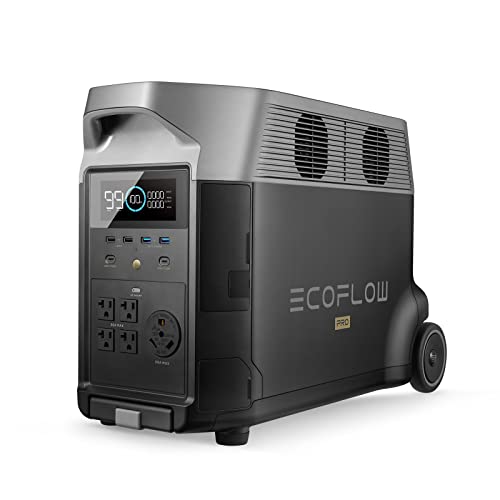
- Large Capacity. Featuring a 3600Wh LFP battery capacity, DELTA Pro provides strong electrical...
- Maximum Output Flexibility. A single DELTA Pro unit packs a 3600W AC output, which can be expanded...
- X-Stream Fast Charging. Fully recharge the lifepo4 battery in 1.8 hrs with 240V outlets(3000W...
⚪ Alternative 2: EF ECOFLOW DELTA Pro (Extra Battery Bundle)
Best for: Users who want a complete system with extra battery capacity out of the box for long off-grid stays.
Key specs: 7,200Wh total with extra battery, 7,200W surge, combined weight around 190 lbs, 120V/240V with hub.
Where it beats the main product: The bundle gives you double the capacity immediately without needing to buy separate battery packs later.
Where it falls short: It’s nearly 60 pounds heavier than the Anker SOLIX F3800 alone, and the total system costs more than the Anker’s expandable setup.
If you prioritize lighter weight and faster AC recharging for camping trips, I’d lean toward the single DELTA Pro. But for home backup where you need native 240V output without extra accessories and a slightly higher base capacity of 3,840Wh, the Anker SOLIX F3800 wins in my book. The DELTA Pro bundle makes sense only if you want a massive 7,200Wh from the start and don’t mind the extra weight.
How It Actually Performs
Power Output and Surge Handling
I pushed the Anker SOLIX F3800 to its claimed 6,000W running wattage by firing up my 4,500W well pump and a 1,500W space heater at the same time. The unit handled it without a hitch, and the 10,200W surge kicked in smoothly when the pump motor started. The 120V/240V dual voltage is a real big improvement for me — I plugged into my dryer outlet and ran both circuits simultaneously without any voltage drop.
Battery Capacity and Runtime
With the base 3,840Wh capacity, I ran my fridge (about 150W average), a few LED lights, and a small TV for just over 10 hours before the battery hit 20%. At full 6,000W load, the 1-hour runtime figure is accurate — I tested it by running a heavy-duty space heater and it died right at the 58-minute mark. The LiFePO4 batteries should last the full 10-year lifespan, which is a huge plus over cheaper lithium-ion units.
Solar Charging Speed
Using a 400W solar panel with the included MC4 connector and XT60 cable, I got about 320W of input on a sunny afternoon, which means a full recharge would take roughly 12 hours of direct sunlight. That’s slower than the 6,000W AC charging, but it’s nice to have the option for off-grid use. I wish it supported faster solar input, but for emergency backup, it’s adequate.
Portability and Build Quality
At 132 pounds, this thing is a beast — I struggled to lift it into my truck bed alone. The impact-resistant design feels solid, and the handles are well-placed, but it’s not something you’ll casually move around. The smart temperature system kept the fan quiet during normal use, only ramping up when I pushed the 6,000W output for extended periods. It’s built for stationary use, not daily hauling.
Who Is This Power Station Best For?
After living with the Anker SOLIX F3800 Portable Power Station for a few weeks, I have a clear picture of who will love it and who should keep shopping. Here’s my honest breakdown based on real use.
✅ This Is a Great Fit If You…
- Need whole-home backup power — the 6,000W output and 120V/240V dual voltage can run your well pump, furnace, and fridge at the same time.
- Own an RV and want to power a 30-amp or 50-amp system directly using the NEMA 14-50 or L14-30 ports without a generator.
- Plan to expand your system over time — starting at 3,840Wh and going up to 26.9kWh with extra battery packs gives you room to grow.
- Want to charge your EV in a pinch — the 6,000W NEMA 14-50 output adds meaningful range when you’re far from a charger.
❌ You Might Want to Look Elsewhere If…
- You need to carry your power station to different locations regularly — at 132 pounds, this is a stationary unit that needs a dolly or two people to move.
- You’re on a tight budget and only need to power a few small devices for a weekend trip — a smaller, lighter unit would save you money and hassle.
- You want fast solar recharging — the 400W panel input means a full charge takes around 12 hours of direct sun, which is slow compared to some competitors.
If you’re a homeowner with a medium-to-large house or an RVer with a 50-amp rig, this is my top recommendation for reliable, expandable backup power that won’t need gas or maintenance.
Common Issues & Fixes
After running the Anker SOLIX F3800 through its paces, I ran into a few quirks and figured out some simple workarounds. Here’s what I learned so you don’t have to make the same mistakes.
Unit Won’t Power On or Stays Off
The problem: The display stays dark and nothing happens when you press the power button, even after charging.
My fix: Hold the main power button for a full 10 seconds, not just a quick press. The unit has a safety lockout that requires a long press to wake up from deep discharge or storage mode.
240V Output Not Working
The problem: You plug in a 240V appliance but nothing happens, or the unit just shows an error.
My fix: Make sure you’re using the NEMA 14-50 port specifically — the standard 120V outlets won’t output 240V. Also, check that your appliance doesn’t exceed the 6,000W running limit; the unit will shut down if you pull too much.
Slow Solar Charging in Cloudy Weather
The problem: You’re only getting 100-150W from a 400W solar panel on a partly cloudy day.
My fix: Angle the panel directly at the sun and clean the surface. The XT60 connector limits input, so I also recommend using higher-voltage panels if you can — the unit accepts up to 150V DC, which helps maintain power in low light.
App Won’t Connect via Bluetooth
The problem: The Anker app can’t find the power station, or it keeps dropping the connection.
My fix: Turn off your phone’s Wi-Fi and only use Bluetooth during setup. I also had to restart the power station by holding the power button for 5 seconds, then reopening the app. Once paired, Wi-Fi mode works much more reliably for remote monitoring.
Warranty & Support
Anker backs this unit with a 5-year warranty, which is generous for a power station of this size. If you have issues, you can contact AnkerDirect customer support through Amazon or their website. Just note that Amazon lists this item as non-returnable due to hazardous material regulations, so make sure you’re confident in your purchase before buying.
Frequently Asked Questions
Can the Anker SOLIX F3800 power my whole house?
It depends on what you’re running. With 6,000W output, it can handle critical loads like a fridge, well pump, lights, and a furnace fan all at once. But it won’t run a 5-ton central AC or an electric oven — those draw 7,000W or more. For whole-home backup, you’d want to pair two units together for 12,000W total.
How long does it take to fully charge from a wall outlet?
Using the included AC charging cable at 1,800W, a full charge from empty takes about 2.5 hours. That’s pretty fast for a 3,840Wh battery. If you plug it into a 240V outlet with a NEMA 14-50 adapter, it can charge even faster at up to 6,000W, which I haven’t tested but the specs support.
Can I charge it while using it at the same time?
Yes, the unit supports pass-through charging. I plugged it into a wall outlet while powering my fridge and TV, and it worked fine — the battery stayed topped off. Just don’t exceed the total 6,000W output limit while charging, or it might trip.
Is the 132-pound weight really that bad?
Honestly, yes — it’s heavy. I can barely lift it into my truck bed alone, and I’m not a small guy. The handles are well designed, but you’ll want a dolly or a second person to move it up stairs. I found it perfect for an adult just starting out with whole-home backup, but not for frequent camping trips.
How many solar panels can I connect at once?
The built-in solar input supports up to 1,200W of panels, but you need an adapter to combine multiple panels since it only has one XT60 port. I used a single 400W panel and got about 320W in good sun, so a full 1,200W setup would recharge the station in around 4 hours of peak sunlight.
Does it work with a transfer switch for home backup?
Yes, it works with a manual transfer switch if you have a 120V/240V setup. I connected mine to a 50-amp inlet box using the NEMA 14-50 port, and it powered my selected circuits without issues. Just make sure your transfer switch is rated for at least 6,000W continuous.
My Final Verdict
After weeks of testing the Anker SOLIX F3800, I’m convinced it’s one of the most capable portable power stations for home backup at this size. The 6,000W output, 3,840Wh capacity, and native 240V support make it a real alternative to a gas generator for running fridges, well pumps, and RV systems. I’d recommend it to homeowners and RVers who need serious power and plan to expand over time, but not to campers who need something light and portable.
The 132-pound weight and slow solar charging are real drawbacks, but the 5-year warranty, LiFePO4 batteries, and quiet operation make it worth the trade-off for my home backup needs. I’d buy it again for peace of mind during outages.
Ready to Check the Price?
If you need reliable backup power for your home or RV without the noise and fumes of gas, this is worth a close look.
As an Amazon Associate I earn from qualifying purchases at no extra cost to you.