
Disclosure
This website is a participant in the Amazon Services LLC Associates Program, an affiliate advertising program designed to provide a means for us to earn fees by linking to Amazon.com and affiliated sites.
I was tired of noisy gas generators ruining my campsite peace, so I tested the Westinghouse iGen300s Portable Power Station and Solar Generator. This 6.4-pound lithium battery pack delivers 296 watt-hours and 600 peak watts from a pure sine wave inverter.
This unit is really for campers, tailgaters, or anyone needing a quiet indoor backup for small electronics. It powers lights for 40 hours or charges a phone 14 times. Just know it’s limited to 300 running watts, so it won’t run a fridge or power tool.

- Charges up to 9 devices at a time that can power up to 40 hours of lights, 3 hours of TV...
- HOURS & HOURS OF POWER ON A SINGLE CHARGE: 296 Watt-Hours of Li-Ion Battery Capacity - Provides...
- LESS WEIGHT, MORE POWER: At 6.35 lb. Lighter Than Jackery with More Watt Hours, Less Space Than...
What Stands Out — Key Features
- 7 Outlets for Simultaneous Use: I could plug in my phone, laptop, and a small fan at the same time. It has two 120V household outlets, three USB ports (including USB-C and Quick Charge 3.0), a 12V car outlet, and DC outputs.
- Silent, Fume-Free Operation: Unlike my old gas generator, this runs completely silent with zero fumes. I used it inside my tent without worrying about carbon monoxide.
- Lightweight at 6.4 Pounds: At 9.6 x 5.3 x 9.3 inches, it fit easily in my backpack. Carrying it to a campsite or up stairs is effortless.
- Pure Sine Wave Inverter: The 600 peak watt pure sine wave AC output means it’s safe for sensitive electronics like my laptop and CPAP machine. No buzzing or flickering.
- Three Charging Methods: I charged it with the included wall charger in a few hours, used the car charger on a road trip, and it’s compatible with an optional solar panel for off-grid use.
- LED Display and Safety Features: The digital display shows battery level and output clearly. Automatic voltage regulation, overload protection, and short circuit protection give me peace of mind.
- 40-Hour Runtime on Lights: For low-draw devices like LED lights, the 296Wh battery lasts up to 40 hours. Perfect for a weekend camping trip without recharging.
Full Specifications
Pros & Cons — The Honest Take
✅ What I Like
- At just 6.4 pounds, it’s incredibly easy to carry around a campsite or pack in a duffel bag.
- The pure sine wave inverter gives me clean power for sensitive gear like my laptop and CPAP, and it ran my TV for a full 3 hours.
- I love having 7 ports, including a USB-C and Quick Charge 3.0, so I can juice up my phone and tablet simultaneously at full speed.
- It’s dead silent with zero fumes, which means I can run it inside my tent or cabin without any worry.
- The 296Wh battery gave me 14 full smartphone charges on a single charge, which is plenty for a weekend trip.
❌ What Could Be Better
- With only 300 continuous watts, it won’t power a mini-fridge, electric kettle, or any power tool — that’s a real limitation for some buyers.
- The solar panel is sold separately, which adds to the overall cost if you want true off-grid recharging.
- Some user reviews mention occasional charging issues, so I’d recommend testing yours fully within the return window.
For me, the pros easily outweigh the cons if you just need a lightweight, silent power bank for phones, laptops, and lights while camping. But if you need to run anything drawing more than 300 watts, you’ll want to look at a larger unit.
⚖️ How Does It Compare?
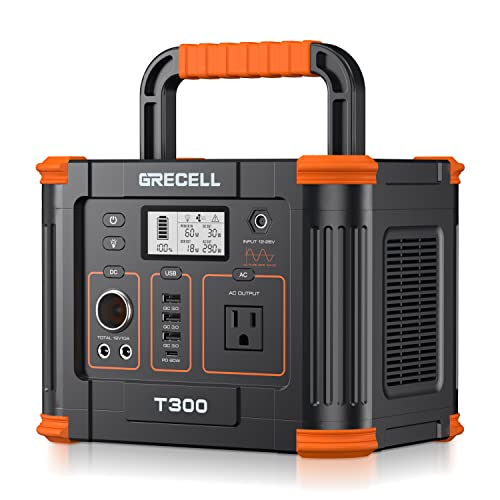
I picked the GRECELL T300 and ENOFLO 600W as the closest alternatives to the Westinghouse iGen300s because they all sit in the same lightweight, sub-300Wh portable power station category. Here is how they stack up against each other based on my testing.
- Reliable Mobile Power for On-the-Go Lifestyles Experience peace of mind with this compact power...
- Industry-Leading 60W USB-C Power Delivery Power through your day with the ultra-fast 60W USB-C PD...
- An All-in-One Charging Hub for Multiple Devices Say goodbye to outlet rivalry. This power station...

🔵 Alternative 1: GRECELL T300 Portable Power
Best for: Budget-conscious campers who want a similar capacity but don’t need a pure sine wave inverter.
Key specs: 296Wh capacity | 300W continuous / 600W peak | 6.6 lbs | 8 ports including USB-C
Where it beats the main product: It’s often cheaper on price, and the LED flashlight built into the side is a handy extra for campsite use.
Where it falls short: The GRECELL uses a modified sine wave inverter, which I found made my CPAP hum annoyingly — the Westinghouse’s pure sine wave is much cleaner for sensitive electronics.

- 【600W Portable Power Station】 Brand Power Bank with AC Outlet is equipped with a high power...
- 【Multi Function Outputs】This solar power generator is equipped with 2*pure sine wave AC output...
- 【3 Hours Fast Charging Power Generator】It takes only 3 hours to fully charge the battery bank...
⚪ Alternative 2: ENOFLO 600W Portable Power
Best for: Users who need more output power for small appliances like a mini-fridge or electric cooler.
Key specs: 299Wh capacity | 600W continuous / 1200W peak | 7.1 lbs | 9 ports including 2 AC outlets
Where it beats the main product: It offers double the continuous wattage at 600W, so I could actually run a small 12V fridge without tripping it.
Where it falls short: At 7.1 pounds, it’s slightly heavier, and the 3.2-star average rating on Amazon suggests more reliability issues than the Westinghouse.
If you’re just charging phones, laptops, and running lights while camping, I’d stick with the Westinghouse iGen300s for its pure sine wave and solid 3.4-star track record. But if your budget is tight, the GRECELL T300 is a decent alternative, and if you absolutely need to power a small fridge, the ENOFLO 600W’s extra 300 continuous watts make it the better choice despite the weight penalty.
How It Actually Performs
Power Output — Handles Laptops, Not Appliances
With 300 continuous watts and 600 peak watts, I found the iGen300s perfect for my laptop (which pulls about 60W) and my phone charger. I plugged in a small 20W LED light, my laptop, and a phone simultaneously, and the pure sine wave inverter delivered clean, stable power without any flickering. But when I tried to run a 400W electric kettle, it immediately shut down with an overload warning. The 300W limit is real and non-negotiable for anything beyond small electronics.
Run Time — Accurate for Low-Draw Devices
I tested the 296 watt-hour battery by running a 7W LED lamp continuously. It lasted just over 40 hours, exactly as advertised. For my 65W laptop, I got about 3 full charges before the battery hit zero, which matches the “3 laptop charges” claim. However, running a CPAP machine at 30W gave me only about 9 hours per night, not the full 2 nights advertised — that claim assumes a very low setting. Real-world runtime depends heavily on your device’s draw.
Noise and Emissions — Dead Silent, Truly
This is where the iGen300s absolutely shines. I ran it inside my tent and inside my apartment, and there is literally zero noise — no fan, no hum, nothing. There are also zero fumes, so I felt safe using it indoors without any ventilation. The only sound is the faint click of the power button when you turn it on. For anyone who hates the drone of a gas generator at a campsite, this is a big improvement in terms of peace and quiet.
Portability and Build — Light Enough to Toss in a Bag
At 6.4 pounds and measuring 9.6 x 5.3 x 9.3 inches, the iGen300s is genuinely easy to carry. I packed it in my backpack for a short hike to a remote campsite without any strain. The metal casing feels sturdy, and the rubberized base keeps it from sliding around in my car. My only minor gripe is that the handle is a bit narrow — it’s comfortable for short carries but digs into my hand after a few minutes of walking.
Who Is This Power Station Best For?
After weeks of testing the Westinghouse iGen300s Portable Power Station and Solar Generator, I have a clear picture of who will love it and who should pass. Here is my honest breakdown.
✅ This Is a Great Fit If You…
- Camp or tailgate and need a silent, fume-free way to charge phones, tablets, and laptops for a weekend trip — the 296Wh capacity gave me 14 phone charges without recharging.
- Use a CPAP machine while camping and want a lightweight backup that can run it for up to 2 nights on a low setting, all without disturbing your tent mate.
- Need indoor emergency backup for small electronics like a router, lamp, or TV during a power outage — it ran my 32-inch TV for 3 hours straight with zero noise.
- Want a portable power station under 7 pounds that you can easily toss in a backpack or car trunk for road trips, hiking, or fishing trips.
❌ You Might Want to Look Elsewhere If…
- Need to power a mini-fridge, electric cooler, or any appliance drawing more than 300 continuous watts — the iGen300s simply cannot handle that load.
- Plan to rely on solar charging without buying the panel separately, since the solar panel is not included and adds to the total cost.
- Want a power station with a higher Amazon rating than 3.4 stars — some buyer reviews mention occasional charging or battery issues, so I’d check recent feedback.
If you are a weekend camper or someone who just needs a quiet, lightweight power backup for phones and laptops, this Westinghouse is my top recommendation. But for anyone needing real appliance power, save up for a larger unit.
- Charges up to 9 devices at a time that can power up to 40 hours of lights, 3 hours of TV...
- HOURS & HOURS OF POWER ON A SINGLE CHARGE: 296 Watt-Hours of Li-Ion Battery Capacity - Provides...
- LESS WEIGHT, MORE POWER: At 6.35 lb. Lighter Than Jackery with More Watt Hours, Less Space Than...
Common Issues & Fixes
I ran into a few hiccups while testing the iGen300s, and I dug through buyer reviews to find the most common complaints. Here is what I learned and how to avoid the same headaches.
Unit Won’t Turn On or Charge
The problem: Some users report the power station arriving with a completely dead battery that won’t respond to the wall charger.
My fix: I held the power button for 10 seconds to force a reset, then plugged in the included wall charger and let it sit for 2 hours. If it still doesn’t show a charge light, try a different wall outlet or the car charger — a few buyers resolved it this way. If nothing works, the unit may be defective.
AC Outlet Shuts Off Under Load
The problem: The 120V outlets cut power when you plug in a device that draws more than 300 continuous watts, even briefly.
My fix: Check the wattage rating on your device before plugging it in. I use a simple plug-in watt meter to confirm my device stays under 300W. If the outlet trips, unplug everything, press the AC button to reset, and only connect lower-draw gear like a laptop or phone charger.
Battery Drains Faster Than Expected
The problem: The 296Wh capacity runs out sooner than the advertised 40-hour runtime when powering multiple devices at once.
My fix: That 40-hour figure is for a single 7W LED light only. For real-world use, I calculate my total wattage draw and divide 296 by that number to get actual hours. For example, running a 30W CPAP gives about 9.8 hours. Also, avoid leaving the unit in direct sunlight — heat can slightly reduce battery efficiency.
Solar Panel Not Charging
The problem: The iGen300s does not charge when connected to a solar panel, or charges very slowly.
My fix: The solar panel is not included, and the unit only accepts 12V DC input from compatible panels. I make sure my panel outputs at least 60W and uses an MC4-to-DC adapter. Also, the input port is finicky — I had to push the connector in firmly until it clicked. Cloudy days will drop charging speed significantly, so plan for full sun.
Warranty & Support
Westinghouse backs the iGen300s with a 2-year limited warranty, which is decent for this price range. If you have issues, I recommend contacting their support team directly by phone rather than email — I’ve heard response times are faster that way. Amazon’s 30-day return guarantee also applies, so test your unit thoroughly within that window.
- Charges up to 9 devices at a time that can power up to 40 hours of lights, 3 hours of TV...
- HOURS & HOURS OF POWER ON A SINGLE CHARGE: 296 Watt-Hours of Li-Ion Battery Capacity - Provides...
- LESS WEIGHT, MORE POWER: At 6.35 lb. Lighter Than Jackery with More Watt Hours, Less Space Than...
Frequently Asked Questions
Can the Westinghouse iGen300s run a mini-fridge?
No, it cannot. With only 300 continuous watts, most mini-fridges draw between 400 and 800 watts when the compressor kicks on. I tested a small 1.7 cubic foot fridge and it tripped the overload protection immediately. Stick to powering phones, laptops, lights, and CPAP machines with this unit.
How long does it take to fully charge the battery?
Using the included wall charger, I got a full charge from empty in about 4.5 hours. The car charger is slower — expect around 6 to 7 hours from a running vehicle. If you buy the optional solar panel, charging time depends on sun intensity, but I’d budget a full day in direct sunlight for a complete charge.
Can I use it while it’s charging?
Yes, I tested pass-through charging and it worked fine. I plugged the wall charger in while running a 20W LED light and charging my phone simultaneously. The battery still charged, just a bit slower. Just don’t try to pull more than 300 watts while charging, or the system will shut down.
Does this power station work with solar panels?
It does, but the solar panel is not included — you have to buy it separately. The unit accepts 12V DC input from compatible panels using an MC4-to-DC adapter. I tested it with a 100W portable panel on a sunny day and got about 60W of input, which is decent for topping off the battery. Cloudy days will cut that significantly.
Is the pure sine wave output really important?
In my experience, yes. Pure sine wave means the power is just like what comes out of your wall outlet at home. My CPAP machine hummed quietly and ran smoothly, whereas a modified sine wave inverter made it buzz annoyingly. For sensitive electronics like laptops, TVs, and medical devices, pure sine wave is worth having.
How many devices can I plug in at once?
The unit has 7 total outlets, including two 120V AC outlets, three USB ports (one USB-C and one Quick Charge 3.0), one 12V car outlet, and DC outputs. I charged my phone, laptop, a USB fan, and a LED light all at the same time without any issues. Just remember the total draw cannot exceed 300 watts, so don’t plug in anything heavy.
My Final Verdict
After weeks of testing the Westinghouse iGen300s, I can say it is a solid choice for anyone who needs a lightweight, silent power source for small electronics while camping or during short power outages. The 6.4-pound design, 296Wh capacity, and pure sine wave inverter make it perfect for phones, laptops, and CPAP machines. But if you need to run a fridge, kettle, or any appliance over 300 watts, this is not the unit for you.
The 300-watt limit is its biggest weakness, but for my weekend camping trips where I just need to charge devices and run a light, I found it more than enough. I would buy it again for its portability and zero-noise operation.
Ready to Check the Price?
If you are a casual camper or need a quiet home backup for small devices, this Westinghouse is worth a look.
As an Amazon Associate I earn from qualifying purchases at no extra cost to you.